PATIENT EXPERIENCE, PRODUCT UPDATES, TECHNOLOGY
NPS in Healthcare Explained: Benefits, Calculation & Best Practices
OCTOBER 8,2025 MANU MOHAN

What is Net Promoter Score (NPS) for healthcare?
In healthcare today, patient experience is just as important as medical outcomes. Hospitals are no longer evaluated only on their infrastructure or treatment success rates —what truly matters is how patients feel throughout their care journey. This is where the Net Promoter Score (NPS) comes in.
NPS® is a powerful metric that helps healthcare providers measure patient perceptions, understand satisfaction levels, and identify areas for improvement. By tracking NPS, hospitals can not only enhance the overall patient experience but also strengthen loyalty and ensure continuous improvement in the quality of care.
Why patient experience matters
The impact of patient experience goes far beyond satisfaction scores. It has a direct influence on:
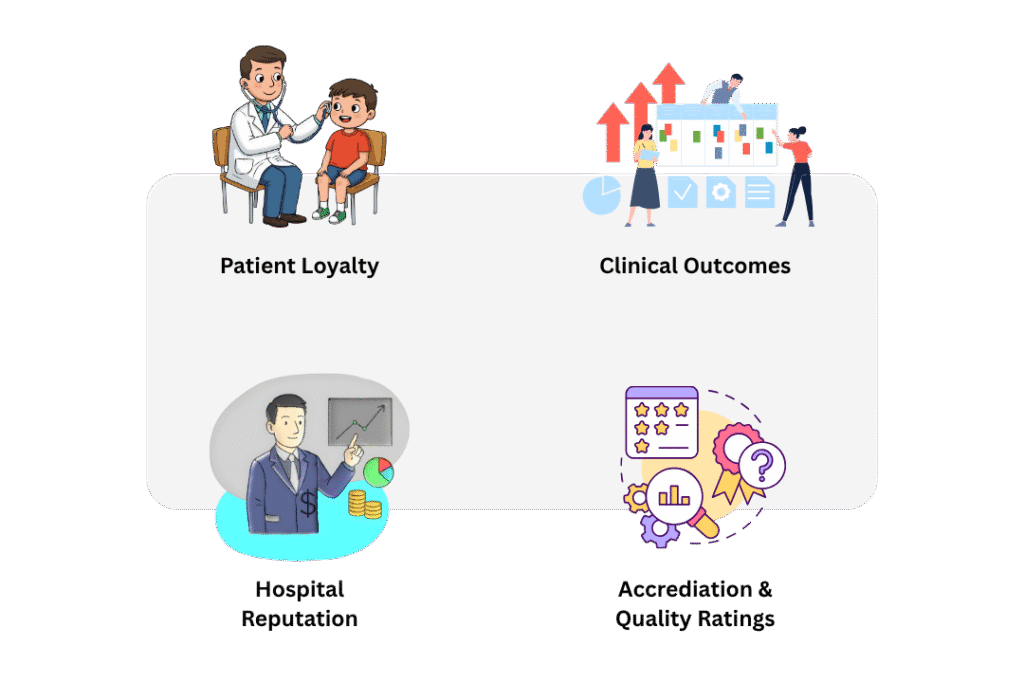
In a competitive healthcare market, a single poor interaction can drive patients away, while a positive experience can turn them into advocates. That’s where NPS proves to be a reliable and scalable way to measure sentiment and guide improvements.
What is Net Promoter Score (NPS®)?
Net Promoter Score (NPS) is a widely used customer experience metric developed by Fred Reichheld of Bain & Company. It helps organizations, including hospitals, gauge patient loyalty and satisfaction using a simple, yet powerful question:
“On a scale of 0 to 10, how likely are you to recommend our hospital to a friend or family member?”
This one question captures how patients perceive the overall care they received and whether they’d advocate for your hospital.
How is NPS calculated?
To calculate your Net Promoter Score, you need to classify responses into three categories:
Classification of Responses
- Promoters (9–10):
Highly satisfied patients who are loyal and enthusiastic about your services. They are likely to recommend your hospital to others. - Passives (7–8):
Satisfied but not overly enthusiastic patients. They are neutral and may easily switch to other providers. - Detractors (0–6):
Unhappy patients who may share negative feedback or discourage others from choosing your services.
NPS formula
Use this formula to calculate NPS:
NPS = % of Promoters – % of Detractors
Example:
If 60% of respondents are Promoters and 20% are Detractors:
NPS = 60 – 20 = 40
This indicates a positive patient sentiment and loyalty score.

Remember, NPS scores are always expressed as whole numbers, not percentages. For example, your score would simply be 40. Since NPS ranges from -100 to +100, the higher the number, the better the score.
Interpreting your score
- Above 0: Positive overall sentiment
- Above 50: Strong patient loyalty
- Above 70: World-class performance
Why is NPS important in healthcare?
NPS goes beyond measuring patient satisfaction — it focuses on loyalty, which is key for sustainable growth and quality improvement. Here’s why it matters:
- Helps identify service gaps and pain points
- Drives referrals and word-of-mouth reputation
- Useful for quality improvement initiatives
- Supports accreditation efforts (e.g., NABH, JCI)
- Provides a benchmark for internal departments and doctors
How healthcare providers can use NPS
Hospitals can integrate NPS at various stages of the patient journeys to gain actionable insights:
Post-discharge surveys
NPS works best when patient feedback is collected soon after their hospital visit or discharge. Sending short surveys via email, SMS, or WhatsApp makes it easy for patients to respond, leading to higher participation. This timely feedback captures fresh impressions, helps address concerns before they escalate, and builds trust with patients.
Department-wise analysis
Breaking down NPS scores by department (such as OPD, emergency, or surgery) gives hospitals a clear view of where services excel and where they fall short. For example, the emergency department might score high on response time but low on communication. This granular view ensures that resources and training are directed to the right areas for maximum impact.
Doctor-specific ratings
NPS can also highlight individual doctor performance, offering valuable insights into bedside manner, communication, and patient engagement. Doctors receive constructive feedback to help them improve patient interactions, while hospital management gains a transparent way to recognize top performers and address skill gaps.
Historical benchmarking
Tracking NPS over time provides a clear picture of patient loyalty trends. Month-on-month and year-on-year comparisons reveal whether improvement initiatives are working or if new challenges have emerged. Consistent benchmarking helps maintain high standards and align hospital goals with patient expectations.
Integration with digital feedback platforms
Platforms like Efeedor streamline the NPS process by automating survey distribution, collecting feedback, and generating insightful reports. This integration reduces manual effort, ensures real-time data availability, and makes it easier for healthcare leaders to act quickly on patient concerns, ultimately driving continuous service excellence.
Limitations and considerations
While NPS is valuable, it should not be used in isolation. Some limitations include:
Lacks context — doesn’t tell why the score was given
NPS provides a numerical measure of satisfaction but doesn’t explain the reasons behind it. A low score could be due to long waiting times, poor communication, or billing issues — without context, it’s hard to know what to fix.
Ignores specific service feedback
The standard NPS question focuses on overall likelihood to recommend, not on individual services or touchpoints. This means certain problem areas, such as cleanliness or discharge process, may go unnoticed unless assessed separately.
Doesn’t capture emotions or nuanced patient stories
Patients often have personal experiences and emotions that a score alone can’t reflect. NPS misses out on detailed narratives, which are often critical for understanding patient sentiment fully.
To get the full picture, pair NPS with:
Patient Experience
Turn patient feedback into measurable satisfaction.
Efeedor connects NPS insights with real-time feedback to help hospitals boost satisfaction, loyalty, and trust at every touchpoint.
Quality & Patient Safety
Track, analyze, and act on every incident.
Efeedor links NPS with safety data, enabling teams to identify root causes, reduce errors, and ensure safer care environments.
Operational Excellence
Streamline workflows for smarter hospital operations.
By integrating NPS with operational metrics, Efeedor helps healthcare leaders enhance efficiency, reduce delays, and deliver better care outcomes.
Together, these three pillars — Patient Experience, Quality & Patient Safety, and Operational Excellence — help hospitals move beyond NPS scores to achieve measurable improvements across every level of care delivery. With Efeedor, feedback turns into action, insights turn into outcomes, and patient trust becomes lasting growth.
Best practices for implementing NPS in hospitals
Implementing NPS effectively requires more than just asking one question. Following these best practices ensures you gather accurate, actionable insights.
Ask at the right time
Sendhe NPS survey immediately after discharge or at the end of a consultation. When the experience is still fresh, patients give more accurate and relevant feedback.
Keep responses anonymous
Patients are more likely to share genuine opinions when they know their identity is protected. Anonymity helps reduce bias and fear of negative consequences, especially when feedback is critical.
Automate the process
Use patient feedback software like Efeedor to automate survey delivery via email, SMS, or WhatsApp. Automation ensures every patient gets a chance to respond, without adding extra work for staff.
Close the loop quickly
Don’t just collect feedback — act on it. Resolve issues promptly and let patients know you’ve listened. This builds trust and shows their voice truly matters.
Train staff with NPS insight
Use NPS trends to identify areas where staff need training — whether it’s improving communication, reducing wait times, or enhancing bedside manners. Continuous improvement leads to consistently better patient experiences.
Use dashboards for better decisions
Dashboards turn NPS scores into clear visual insights. They help hospital leaders spot trends, identify problem areas, and track improvements over time.
Key takeaways
Net Promoter Score is more than a number — it’s a reflection of your hospital’s patient-centric culture. By consistently tracking and acting on NPS, healthcare organizations can:
Build trust and loyalty
Deliver exceptional patient experiences
Achieve clinical and operational excellence
Digital tools like Efeedor can simplify the process by automating NPS collection, analysis, and reporting — helping your hospital stay ahead in a competitive, experience-driven industry.
Frequently Asked Questions
What are the features available in Efeedor to calculate the Net Promoter Score (NPS)?
Efeedor enables hospitals to seamlessly measure patient loyalty through its integrated Net Promoter System (NPS). Hospitals can include the NPS questionnaire directly within the patient feedback form, allowing them to collect loyalty scores from every patient in real time.
The system automatically calculates the Net Promoter Score and provides in-depth analytics, helping hospital stakeholders gain valuable insights into overall patient satisfaction and loyalty trends.
How does Efeedor help hospitals identify promoters and detractors?
Efeedor’s intelligent NPS engine not only calculates the overall score but also automatically classifies patients into Promoters, Passives, and Detractors based on their responses.
The platform presents these results through visual dashboards and periodic trend analyses, enabling hospital administrators and quality teams to easily identify areas of excellence and concern. This empowers hospitals to take targeted actions that enhance patient experience and strengthen loyalty.
What reports can hospitals generate regarding NPS, and how can they use them?
Efeedor provides a comprehensive suite of downloadable NPS reports designed for both operational review and accreditation purposes. Hospitals can generate detailed insights such as:
1. Overall Net Promoter Score
2. Lists of Promoters, Detractors, and Passives
3. Trend analyses over specific time periods
These reports help stakeholders and marketing teams track improvements, identify recurring patterns, and implement strategies to convert detractors into promoters, driving continuous patient satisfaction growth.

Manu Mohan
Founder & CEO, Efeedor | Making Healthcare Experiences Safer, Simpler & More Human
Search
Categories
Recent posts